

141
voice touchpoints
< 1 hr
to launch
24 hrs
to confirm adoption
> 1 min
average message
50%+
leave contact details
In short: Airports do not have a relationship with the passenger. Airlines do. GMR Group, the world's second largest airport operator, changed that at Manohar International Airport. Voicebox went live in under an hour, and within 24 hours the airport knew passengers would use it. Voice touchpoints now run across 141 locations, passengers speak for over a minute on average, more than 70% of what comes in is positive, and more than half of the passengers who record a message leave an email address so the airport can follow up.
The airline knows the passenger. Name, itinerary, loyalty tier, email address, twenty years of history. The airport knows almost nothing. Someone arrives, spends two hours inside a building, buys a coffee and a bottle of whisky, and leaves. No name. No contact. No way to ask them anything and no way to hear from them.
That is an odd position for a business whose reputation is scored on passenger satisfaction and whose margin depends on what those passengers choose to spend inside the terminal. The airport carries the outcome and owns none of the relationship.
What stood in for one was a five-emoji panel outside the restroom. It counts taps. It cannot tell you who tapped. A janitor's elbow on the way past. A child who found something that lights up and tapped it eleven times. A passenger who meant it. All three land in the same column. The other channels were no better: email questionnaires and web forms reach under 2% of people, arrive days late and carry no context. Nobody types a paragraph on their phone while boarding.
So GMR had numbers, but none it would stake a decision on. Untrusted data is a specific kind of expensive. It still gets collected, still gets reported, still gets discussed in a meeting. It just does not change anything.
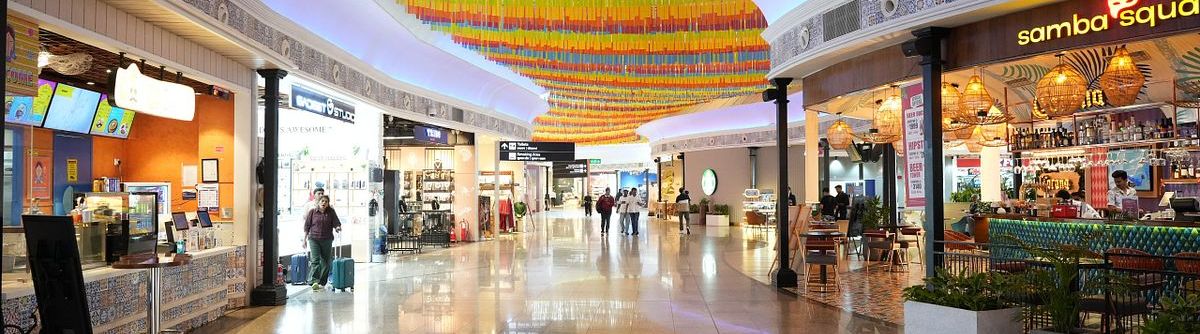
"At Manohar International Airport we are not just facilitating transit, we are engineering a world-class destination experience. My vision is for this airport to be recognised as one of the world's best. Voicebox lets us hear directly from passengers, it helps our terminal team connect, and it will help our retailers gather critical data. It is transforming how we run the place."
R.V. Sheshan, President & CEO, Manohar International Airport
Check-in to gate, the highest-stakes stretch of the journey and the largest audience.
A passenger points their phone camera at a QR code or taps an NFC tag. The browser opens. They speak for five seconds to two minutes, in whatever language they think in. No app. No account. No typing. No form.
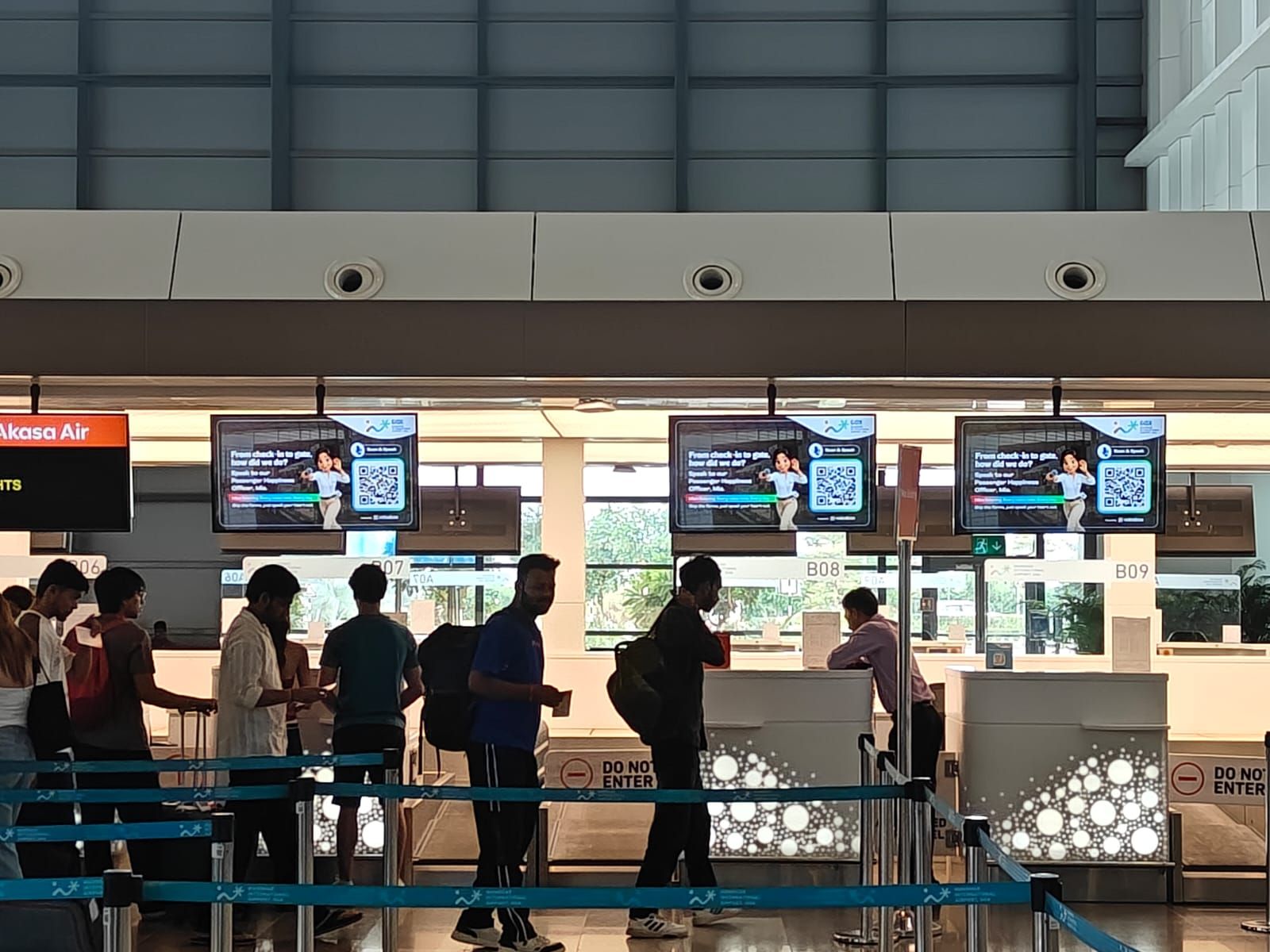
At GOX this did not run on stickers. It ran on the airport's own digital screens above the check-in counters, behind a named airport persona: the Passenger Happiness Officer. For the first time the passenger is talking to the airport, not to the airline and not about the airline. The channel belongs to GOX. Voicebox is the infrastructure underneath it.
Nothing about the channel requires identity. There is no signup and no login, and a passenger can say what they came to say and walk away.
After recording, they are offered one optional field for an email address or phone number, so the airport can come back to them.
More than half of them fill it in.
That number is worth sitting with. The message is already submitted. Nothing is gated behind the field, there is no discount, no draw, no account to create. The passenger has said what they came to say and is free to walk away. Over 50% choose to leave a way to be reached anyway.
Most leave an email address rather than a phone number, which says something about what they expect back. Not a call, not a resolution ticket. A reply.
The airport that could not identify a single passenger is now building a list of people who chose to introduce themselves.
Every touchpoint is mapped to a GPS grid rather than a generic terminal label, so each message carries its own address: which level, which concourse, which counter.
Capture is the easy half. Voicebox transcribes and translates across 100+ languages, strips PII, profanity and spam out of the message, extracts theme and sentiment, then generates a structured ticket and routes it to a mobile device over email, SMS or WhatsApp. It does not populate a dashboard and wait. SOC 2 Type II and GDPR throughout.
< 1 hour Stand up a touchpoint. No integration, no build.
~24 hours Know whether the audience will actually use it.
Then Expand, or stop. Either way you paid a day, not a quarter.
Within a day the airport could see message volume, message length and language mix, and could tell that passengers were speaking rather than tapping. There was no training program. Staff and passengers both understood a microphone button without being taught.
That short loop is why GMR did not wait for a phase-one post mortem before opening the next surface.
"Real transformation in critical infrastructure requires an elegant bridge between ambitious strategic vision and rigorous technical stability. Voicebox is delivering an enterprise ready AI application, which fits the complex operational realities of an international airport, without adding any friction to the passenger."
S.J. Vijay, Founder & Chairman, Salmon Leap Ventures
Every message has an author. Nobody records a minute of speech by accident, and nobody does it eleven times for fun. A voice message authenticates itself: a real person, at a known location, at a known moment, with a reason in their own words. The ambiguity that made tap counts unusable is gone.
People talk for longer than they will ever type. The average message runs over a minute of continuous narrative. Ten times more distinct, actionable themes reach the airport than the legacy panels and questionnaires ever surfaced, each with the reason attached. A three-star rating cannot tell you why the check-in queue frustrated someone. A voice message does.
They use their own language. English leads. A large share speak Hindi. Nobody had to choose from a menu or find the right form.
And most of them are happy. More than 70% of messages carry positive sentiment. Worth stating plainly, because the assumption behind every complaint form is that only angry people will use it. Remove the friction and much of what you hear is people telling you what worked and what they wanted. That is a commercial input, not a service ticket.
GMR is now expanding the surface area, week by week, on two fronts running in parallel with phase one.
Terminal operations. The same channel pointed inward, so frontline staff can report by speaking instead of coordinating across WhatsApp groups, Teams and phone trees.
Retail and dining. Over 140 operators on shared infrastructure, with prompts written in GOX's own voice, so a passenger can say what is missing from the shelf while there is still time to restock it.

"The commercial vitality of this airport relies on our vibrant retail and dining partners. Voicebox gives them something new: a passenger says into their phone what they wanted and could not find, while there is still time to do something about it. No extra staff. No complex tech. Real-time passenger sentiment turned directly into non-aeronautical revenue. That is where we are taking this next."
Akash Srivastava, Chief Commercial Officer, Manohar International Airport
Every enterprise already has systems that record what it did to the customer. Bookings, transactions, tickets, clickstream. That is observed data. It tells you what the company saw.
Zero-party data is different. It is what the customer chose to tell you, deliberately, unprompted, in their own words.
Count how many sources of it your company actually has. A preference center with four checkboxes. A quiz at signup. Reviews, which reach roughly 2% of customers and skew to the extremes. A loyalty profile filled in once and never updated. Thin, structured, stale on arrival.
A minute of continuous speech from a passenger at a check-in counter is not comparable to a five-star tap. It is the richest zero-party source most enterprises will ever have, and for most of them it is currently the only one. It also arrives with something no analytics stack produces: a contactable audience. More than half the people who speak leave a way to reach them.
That record feeds every AI system you have already paid for. Today it is descriptive: what happened, where, why. Twelve months of it becomes predictive. Which counter degrades before it degrades. Which SKU moves in December. Which zone generates complaints before the season starts. No model gets there without the data underneath it, and this data does not exist anywhere else, at any price.
This is the data your competitors cannot buy. They cannot scrape it. They cannot glean it.
It is not sitting in a data broker's catalog, because nobody owns it to sell. It is not on the open web, because it was never published. It cannot be inferred from transactions, because a purchase records what someone did, never what they wanted and could not find. It exists only if you opened the channel that collects it.
Which makes timing the whole game. A competitor who starts a year from now starts with a year of nothing. The record compounds, it cannot be bought, and the lead only widens.
And most companies are in the airport's position more than they admit. If your customer reaches you through an airline, a retailer, a distributor, a marketplace, a platform or a corporate client, then somebody else holds the relationship and you inherit the verdict. You are judged on an experience you cannot hear.
An airport is the hardest version of that problem: transient people, a hundred languages, dozens of independent operators, zero tolerance for friction, and no name to attach to anyone. It works there, and it took a day to find out.
It works on a shelf, a table, a package, a receipt, a hotel room, a clinic, a campus. It works in an email, an SMS, a website embed, an app pop-up.
Anywhere you can put a link, you can open the channel.
Voicebox. No signups. No forms. No apps. Just speak.
